To Kyoto where the charm is refined every day!
The attraction of Kyoto, one of Japan’s leading tourist destinations, is the number of historical streets and temples. If you walk in Gion, you can immerse yourself in elegance on the stone pavement, and in the precincts of Kiyomizu-dera, you can immerse yourself in the history of peace. It is also an area where you can enjoy the atmosphere of each of the four seasons throughout the year, regardless of the season.
How about discovering a new side of Kyoto and a little-known spot that is becoming more and more attractive as a tourist destination as the number of foreign tourists increases?
1.Gion / Higashiyama
●Kiyomizu Temple
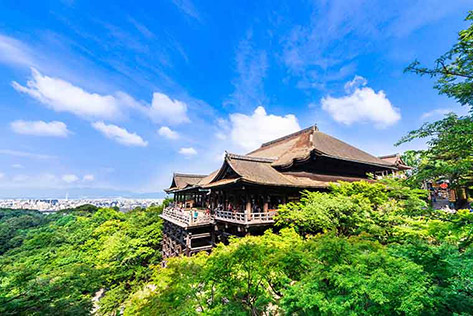
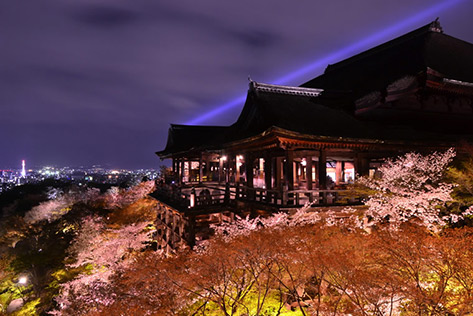
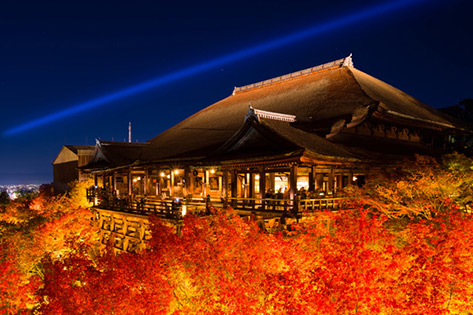
Kiyomizu-dera, a tourist attraction that represents Kyoto and is registered as a World Heritage Site. The three-storied pagoda on the hillside of Mt. Otowa, the main hall known for the stage of Kiyomizu, and the inner temple form a magnificent cathedral. I am surprised that no nails are used for the pillars that support the stage built on the cliff.
The spectacular view of Kyoto city from the stage of Kiyomizu is a must-see! Not only that, but the beautiful scenery that attracts many tourists throughout the year, such as cherry blossoms in spring, fresh green in early summer, and colored leaves in autumn, spreads out.
●Nineizaka, Sanningzaka, Shimizuzaka
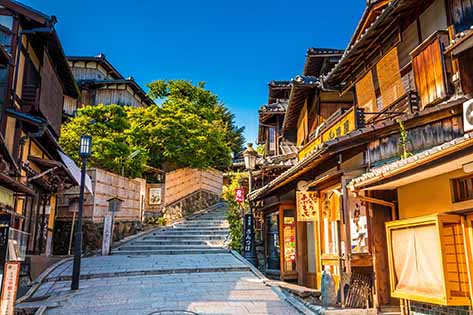


The approach to Kiyomizu-dera continues from Nineizaka (Ninenzaka) to Sanningzaka (Sannenzaka) to Kiyomizuzaka, making it the number one tourist street in Kyoto that is crowded with many people throughout the year. Along the quaint cobblestone slopes, you will find fashionable shops such as souvenirs, sweets, and Japanese goods that are typical of Kyoto.
In Ninenzaka, there is also “Starbucks Coffee Kyoto Ninenzaka Yasaka Chaya”, which has tatami mat seats in a Japanese house that is over 100 years old. At the tourist information center “Yuya”, you can also use the toilet, which is convenient for a short break during your walk.
●Kodaiji Temple


This temple was built by Toyotomi Hideyoshi’s regular room, Kodai-in Nene, and is known as the “Nene Temple”. It is also famous for its cherry blossoms and autumn leaves, and it is lit up when it is in full bloom.
The Nene-no-michi, a cobblestone road with granite that continues to the west of Kodaiji, is also recommended for a walk.
●Yasaka Shrine
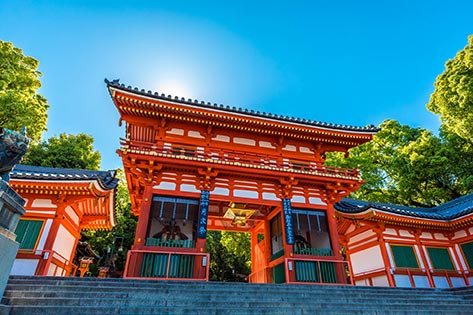


Yasaka Shrine, the guardian deity of the city of Kyoto, is popular as a shrine that has the benefits of warding off evil, eliminating plague, and prospering business.
At the “Utsukushi Gozensha” on the east side of the main shrine, the sacred water called “beauty water” springs up, and it is popular because it polishes the health and mind of the skin beautifully. On the west side of the main shrine, “Okuninushisha”, which is said to be beneficial for marriage, also has a cute heart-shaped votive tablet, which girls cannot miss.
In addition, one of Japan’s three major festivals, the Gion Festival, which takes place over the course of one month in July, is a festival at Yasaka Shrine. The highlight of the festival, the floats that go around the city of Kyoto, is registered as a UNESCO Intangible Cultural Heritage as the “Kyoto Gion Festival floats event”.
2.Around Kinkakuji Temple

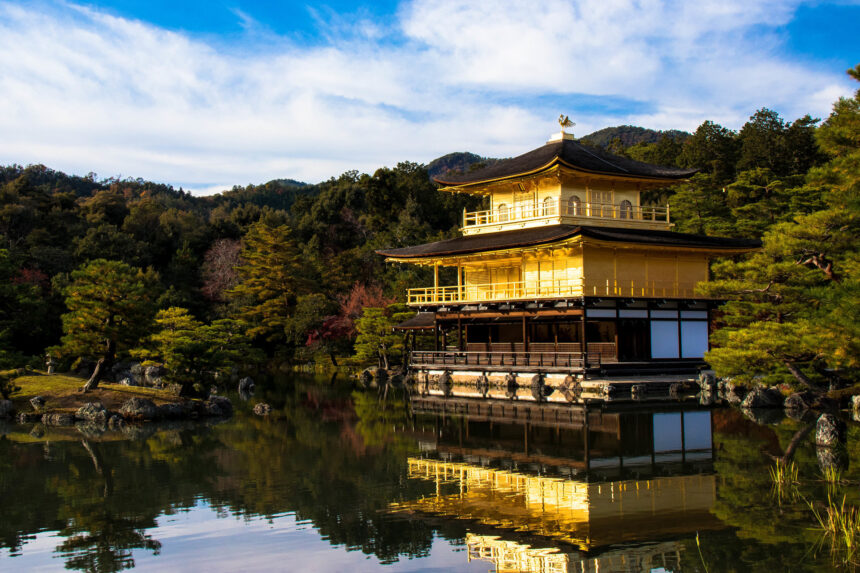
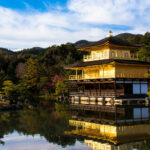
It is a temple of the Rinzai sect Sokokuji school and is famous as “Kinkakuji”, but it is officially called “Rokuonji”. Each of the three layers has a different architectural style, and its appearance using about 200,000 pieces of gold leaf is a beauty that attracts attention from all over the world. It is also registered as a World Heritage Site. This is a must-see tourist attraction if you are visiting Kyoto for the first time.
●Ninnaji Temple


Ninnaji Temple Omurozakura Ninnaji Temple
Ninnaji, the head temple of the Shingon sect Omuro school, is one of the constituent heritage sites of the world heritage “Historic Monuments of Ancient Kyoto”. In addition to the national treasure Kondo, there are many temples on the left and right, such as the Nioumon Gate, the palace, and the five-storied pagoda.
There is a forest of “Omurozakura”, which is famous as the latest blooming cherry blossom in Kyoto, and it has been loved by people for a long time.
●Ryoanji Temple

Ryoanji Temple
The famous Zen Buddhist temple “Ryoanji”, which is famous for its stone garden, is also registered as a World Heritage Site. A beautiful dry landscape garden made of only 15 stones and white sand in 75 tsubo surrounded by a Tsukiji wall. The 15 stones are not all visible at once, or the walls are lowered towards the back using perspective, hiding detailed calculations.
3.Kyoto Imperial Palace
 紫宸殿
紫宸殿


“Kyoto Gyoen” is a vast park with an outer circumference of about 4km that surrounds the “Kyoto Imperial Palace” where the emperor lived until the Meiji era. It is said that there are about 50,000 trees growing in the garden, and you can enjoy walking through the four seasons such as plums, cherry blossoms, peaches, and maples.
The Imperial Palace is also open to the public for free, and the “Shishinden” where the emperors of the Meiji, Taisho, and Showa eras were held, and the “Seiryoden” where the emperor lived his daily life.
●Former Rikyu Nijo Castle


“Nijo Castle” was built by Ieyasu Tokugawa in 1603 as a guardian of the Kyoto Imperial Palace and as a lodging place for Shogun Shogun Ieyasu, and was completed by the third Shogun Ieyasu. It is registered as a World Heritage Site. The highlights are the structure that feels the mighty power of the Tokugawa family, the barrier paintings, and the Karamon gate with its stunning sculptures. The Ninomaru Palace Hall, where the 15th Shogun Yoshinobu announced the repatriation of the Taisei Hokan, is also a must-see. In spring, cherry blossoms bloom in various parts of the castle, creating a gorgeous atmosphere.
4.Around Ginkakuji

“Ginkakuji” is said to have been named “Ginkakuji” for Kinkakuji in the Edo period. Officially called “Jishoji”, the mountain villa built by Yoshimasa Ashikaga was renamed to the temple of the Rinzai sect after Yoshimasa’s death. It is popular as a spot where you can feel the world view of Wabi-Sabi that reflects Yoshimasa’s aesthetic sense. It is registered as a World Heritage Site.
●Philosopher’s walk


It is said that this name was given because it is a walking path along the canal that runs from Nyakuoji Shrine to Ginkakuji, and is a walking path where the leading Japanese philosopher, Kitaro Nishida, indulged in thought. It is also popular as a famous place for cherry blossoms, and in the spring, about 400 Yoshino cherry trees color the journey of about 2 km. It is a walking path that you can enjoy differently whenever you visit, such as fresh greenery and autumn leaves.
●Heian Shrine

It was founded in 1895 in the 1100th year of the Heian period, with Emperor Kanmu as the deity. The vermilion and green shrines standing in the precincts covered with white sand are beautiful, and especially in the spring, the cherry blossoms are in full bloom and crowded with tourists holding cameras.
In addition, on October 22, one of the three major festivals in Kyoto, “Jidai Matsuri,” was held, and a procession of people dressed in eight eras, such as Edo, Muromachi, and Kamakura, was played from the Kyoto Imperial Palace to Heian Jingu. Cruise with. You can see the procession just like a picture scroll in front of you.
●Nanzenji Temple


Nanzenji Temple, the head temple of the Rinzai sect Nanzenji school, is known as a famous spot for autumn leaves. The large “Sanmon”, which is one of the three major gates in Japan and is also an important cultural property, can be climbed, and you can see a magnificent view from above. In addition, there are barrier paintings that are said to have been written by Kano Tanyu, and a dry landscape garden that is said to have been made by Kobori Enshu.
The brick “Suirokaku” in the precincts is also a must-see spot. It often appears in suspense dramas where the criminal confesses, so many people may have seen it.
In addition, Nanzenji Temple is famous for Yudofu, and there are many famous Yudofu shops such as “Junsei” and “Okutan” in the vicinity.
5.Fushimi / Uji
●Fushimi-Inari Taisha


The main shrine of Inari Shrine, which has gained faith as a god of prosperous business and abundant harvest, and has reached about 30,000 nationwide. Many shrines and mounds are scattered on Mt. Inari behind the main shrine, and the “Senbon Torii”, which is lined with many devoted vermilion torii gates, is a masterpiece. In recent years, it has been well received by foreign tourists and has become a very popular tourist spot visited by many people.
Check out the “Omokaru Stone” at the end of the Senbon Torii gate. It is said that you make a wish in front of the stone lantern, lift the stone on the head of the lantern, and if it is lighter than expected, your wish will come true, and if it is heavy, it will not come true.
●Byodoin

Fujiwara no Michinaga’s villa was changed to a temple in 1053 by his child, Yorimichi, and was called “Byodo-in Temple”. It is currently registered as a World Heritage Site. The “Phoenix Hall” drawn on the back of the 10-yen coin is still preserved as a symbol of the Fujiwara customs era.
In addition, at the Byodoin Museum Hoshokan, you can see a vivid restoration video exhibition by CG, 26 statues of the Bodhisattva in the clouds, a national treasure, and a pair of phoenixes.





この記事へのコメントはありません。